Metal Nuts
Coupling Nuts
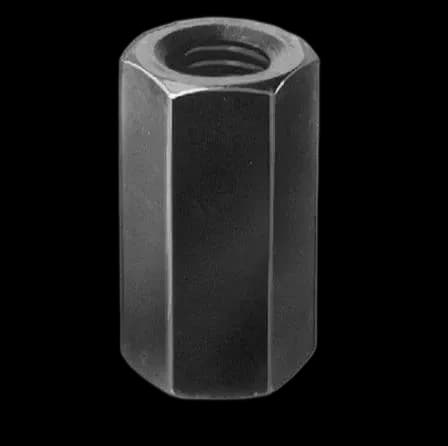
Coupling nuts are elongated internally threaded fasteners engineered specifically to join two external machine threads, such as threaded rods, studs, or piping. Their extended hexagonal body allows for greater thread engagement length, significantly distributing tensile load and minimizing the risk of thread stripping or galling under high-stress conditions. Manufactured to standards like ASTM A563, they are vital components in structural tie rod systems, heavy HVAC suspension systems, and industrial machinery where precise distance adjustments and rod extensions are required.
Coupling NutExtension NutThreaded Rod CouplerConnector NutStructural FastenerAlignment SystemStand-Off SpacerIndustrial Fasteners
Specifications
Design Features
Reducing couplingSight holeTurnbuckle sleeve
Finishes
Zinc PlatedHot-Dip GalvanizedBlack OxidePlainPhosphatingNickel PlatingPTFEZinc Flake CoatingZinc-Aluminium Flake Coating
Grades
A2A4
Materials
Carbon SteelAlloy SteelStainless SteelBrassAluminumCopperSilicon Bronze
Standards
ISO 8434-1DIN 6334DIN 3870ASTM F1554ASTM A194ASTM A108ASME B18.2.2ASTM A563
Thread Types
Unified National Coarse (UNC)Unified National Fine (UNF)UN (Fixed Pitch)ISO MetricBSWACMELeft-Hand Threads
Introduction
Coupling nuts, also known as extension nuts, are elongated internally threaded fasteners engineered specifically to join two external machine threads, such as threaded rods, studs, or piping. Their extended hexagonal body allows for a greater thread engagement length compared to standard nuts, significantly distributing tensile load and minimizing the risk of thread stripping or galling under high-stress conditions. By functioning as a continuous threaded connector, they provide a reliable, high-strength linkage essential for precision distance adjustments and structural extensions in demanding engineering environments.
Materials and Finishes
To accommodate diverse industrial requirements, coupling nuts are manufactured from a wide array of robust materials. Typical choices include Carbon Steel and Alloy Steel for heavy-duty structural applications, alongside Stainless Steel (Grades A2 and A4) which provides excellent corrosion resistance. For specialized environments, materials such as Brass, Aluminum, Copper, and Silicon Bronze are also utilized.
Surface finishes further enhance the durability and operational lifespan of these fasteners. Available finishes include Zinc Plated, Hot-Dip Galvanized, and Black Oxide, which are popular for general structural use. Additional protective coatings like Phosphating, Nickel Plating, PTFE, Zinc Flake Coating, and Zinc-Aluminium Flake Coating offer superior resistance to environmental degradation, while Plain finish options remain available for custom or low-exposure applications.
Technical Specifications and Standards
Coupling nuts are produced in strict adherence to international dimensional and mechanical standards to ensure structural integrity and compatibility. Key standards governing their dimensions and property requirements include DIN 6334 (often referred to as 3d nuts due to their elongated height), DIN 3870, ISO 8434-1, and ASME B18.2.2. Material and mechanical property compliance is typically guided by ASTM A563, ASTM F1554, ASTM A194, and ASTM A108.
These fasteners incorporate various design features, such as reducing coupling configurations to join rods of different sizes, sight holes for visual verification of thread engagement, and turnbuckle sleeves for dynamic tensioning. Thread types available include Unified National Coarse (UNC), Unified National Fine (UNF), UN (Fixed Pitch), ISO Metric, BSW, ACME, and Left-Hand Threads, ensuring broad compatibility across mechanical systems.
Common Applications and Industries
Because of their exceptional load-bearing capacity and versatile design, coupling nuts are vital components across multiple industries. They are heavily utilized in structural tie rod systems for commercial construction, providing critical load distribution. Additionally, they are standard hardware in heavy HVAC suspension systems, where precise distance adjustments and rod extensions are required to support large ductwork and equipment. Industrial machinery assemblies and piping networks also rely on coupling nuts to maintain secure, aligned, and adjustable mechanical connections.
Coupling Nuts — Full Specifications
Our coupling nuts are available in a range of sizes, materials, and standards. Contact us for a detailed specifications sheet and competitive bulk pricing.
Request a Quote