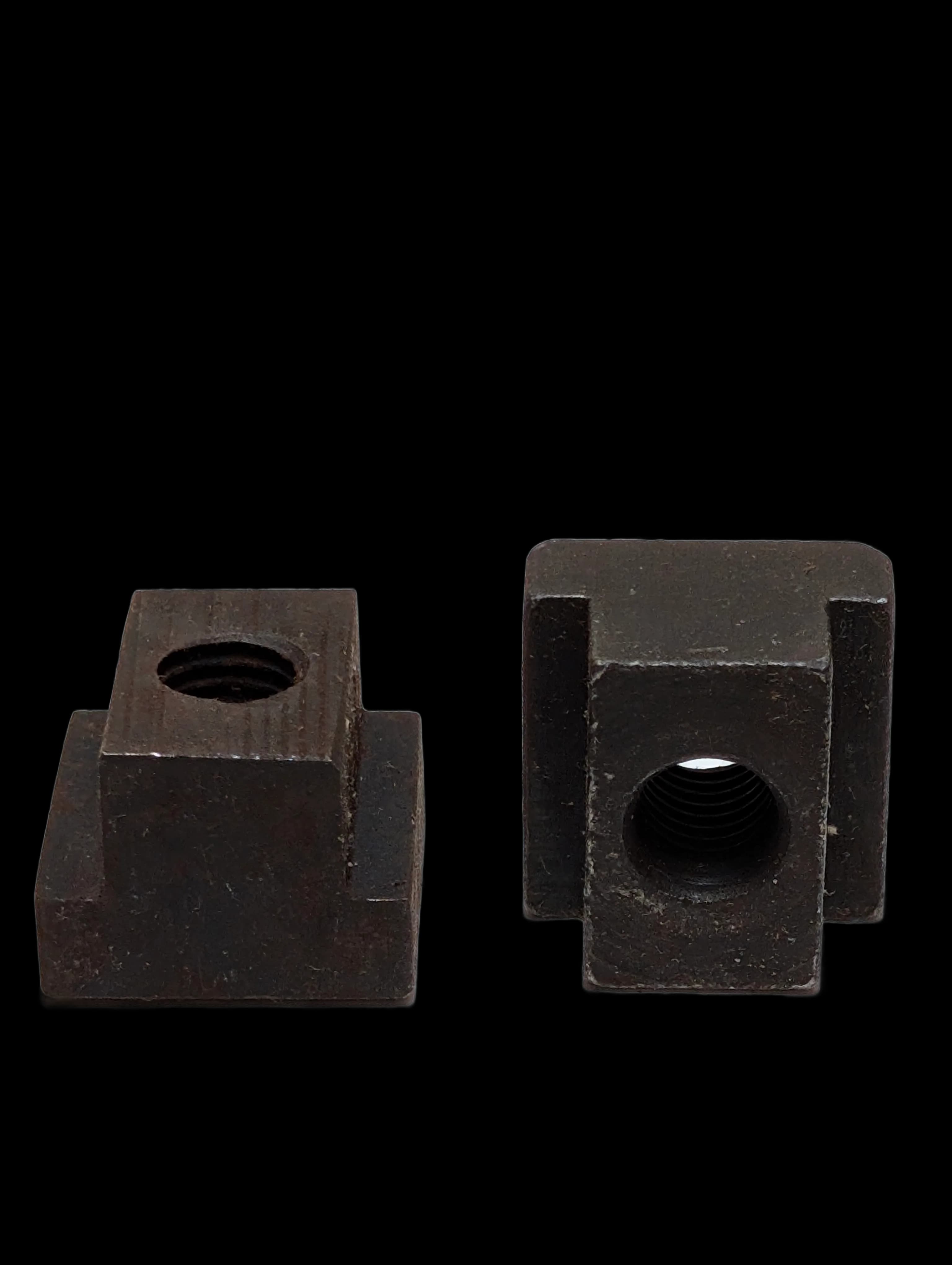
Clamping Fasteners
T-Nuts
T-nuts are internally threaded fasteners that distribute clamping loads over an extended flange surface, thereby increasing pull-out resistance in composite materials or T-slot extrusions. The pronged variants provide anti-rotation anchoring in soft substrates, while the sliding variants lock dynamically within metallic grooves. These fasteners are integral to the structural assembly of modular industrial frameworks, CNC machine beds, and heavy-duty load-bearing composite structures.
T-NutTee NutT-Slot NutBlind NutFlush MountPull-Through ResistanceModular ConstructionWorkholding
Specifications
Finishes
Black OxideZinc Plated
Grades
304316Class 8A2A4
Materials
Stainless SteelAlloy SteelAluminumBrassNickel AlloysCarbon Steel
Slot Sizes
8mm10mm12mm14mm16mm18mm
Standards
DIN 508DIN 650ISO 299ASME B5.1MASME B18.5ISO 898-2
Thread Types
M6M8M10M12M163/8-161/2-13
Introduction
T-nuts, frequently referred to as tee nuts or T-slot nuts, are specialized internally threaded fasteners designed to distribute clamping loads over an extended flange surface. This unique geometry significantly increases pull-out resistance, allowing them to provide strong, flush-mount anchoring points in relatively soft or composite materials, as well as in metallic T-slot extrusions. While pronged variants are hammered into wood or composites to provide anti-rotation anchoring, sliding T-slot variants dynamically lock within metallic grooves to facilitate highly modular and adjustable clamping systems.
Materials and Finishes
Given their diverse applications, T-nuts are manufactured from a wide variety of materials. Heavy-duty workholding and structural T-nuts are typically machined from Carbon Steel, Alloy Steel, and Stainless Steel (including grades 304, 316, A2, and A4, as well as Class 8 strength levels). For specific environmental or conductivity requirements, Aluminum, Brass, and Nickel Alloys are also extensively used.
To ensure longevity, especially in machining environments exposed to coolants and friction, surface finishes are applied. The most common finishes include Black Oxide, which offers mild corrosion resistance while maintaining tight dimensional tolerances, and Zinc Plated, which provides a more robust sacrificial barrier against rust and environmental wear.
Technical Specifications and Standards
In industrial contexts, T-nuts are heavily standardized to ensure perfect compatibility with machine tables and aluminum extrusions. Critical dimensional and tolerance standards include DIN 508, ISO 299, and ASME B5.1M, which define the geometry of the nut itself, while DIN 650 covers the dimensions of the corresponding T-slots. Material strength is often guided by standards like ISO 898-2 and ASME B18.5.
T-nuts are designed to fit precise Slot Sizes, commonly ranging through 8mm, 10mm, 12mm, 14mm, 16mm, and 18mm widths. The internal thread types must accommodate standard clamping hardware and include metric profiles such as M6, M8, M10, M12, M16, as well as imperial threads like 3/8-16 and 1/2-13. This meticulous standardization guarantees that a T-nut will seamlessly integrate into a standardized slot without binding or excessive play.
Common Applications and Industries
The modular and high-strength nature of T-nuts makes them indispensable across numerous industries. In manufacturing and machining, T-slot nuts are integral to the structural assembly of CNC machine beds, where they provide adjustable, rigid workholding points for clamps and vises. They are equally critical in the construction of modular industrial frameworks built from aluminum extrusions, allowing for the rapid assembly of custom workstations and robotics enclosures. In non-metallic applications, pronged T-nuts are widely used in heavy-duty load-bearing composite structures, furniture manufacturing, and climbing wall construction to provide reliable blind nut fastening.
T-Nuts — Full Specifications
Our t-nuts are available in a range of sizes, materials, and standards. Contact us for a detailed specifications sheet and competitive bulk pricing.
Request a Quote