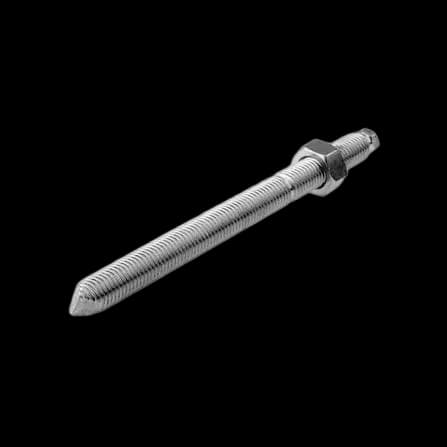
Anchor Bolts
Chemical Anchors
Chemical anchors employ epoxy, vinylester, or polyester resins to encapsulate threaded rods, forming a high-strength, expansion-free bond with concrete or masonry substrates. Because they do not exert radial stress, they permit tight edge spacing and offer superior resistance to dynamic loads, vibrations, and corrosive environments. They are mandated for safety-critical structural steel reinforcements, heavy machinery mounting, and infrastructure retrofitting in cracked concrete.
Chemical AnchorResin AnchorBonded AnchorInjection MortarEpoxy FastenerHigh StrengthNo Expansion StressHeavy Duty Fixing
Specifications
Applications
Concrete (cracked, un-cracked)MasonryHollow brickHigh-load structural applications
Cure Time Requireds
Yes (depends on resin)
Finishes
Zinc PlatedHot-Dip GalvanizedPassivated
Grades
Class 5.8Class 8.8Class 10.9A2A4
Load Distributions
Uniform Bond Stress
Materials
Carbon SteelEpoxy ResinVinylester ResinPolyester ResinStainless Steel
Standards
DIN 976ASTM E1512ISO 898ASTM A706ASTM C881ASTM F1554ASTM E488ASTM A615ASTM A193EAD 330499-00-0601
Thread Types
Fully Threaded RodStud
Introduction to Chemical Anchors
Chemical anchors represent a highly advanced fastening technology engineered for creating extreme-strength, expansion-free bonds within concrete and masonry substrates. Unlike traditional mechanical anchors that rely on friction and exert radial stress on the surrounding material, chemical anchors utilize high-performance resins—such as epoxy, vinylester, or polyester—to encapsulate threaded rods or studs. This chemical bonding process integrates the fastener directly with the substrate, forming a uniform bond stress distribution.
Because they do not exert expansive forces, chemical anchors permit tight edge spacing and close anchor-to-anchor placement without risking substrate fracture. This makes them exceptionally suited for heavy-duty fixings, retrofitting, and environments subjected to dynamic loads, constant vibrations, and corrosive elements.
Materials and Finishes
The efficacy of a chemical anchor system relies on the synergy between the resin matrix and the metallic fastener. The bonding agents are meticulously formulated using premium resins:
- Epoxy Resin: Offers the highest bond strength and durability, ideal for critical structural applications.
- Vinylester Resin: Provides rapid curing times and excellent chemical resistance.
- Polyester Resin: A versatile and cost-effective solution for general masonry and hollow brick applications.
The accompanying hardware—typically Fully Threaded Rods or Studs—is manufactured from high-tensile Carbon Steel or Stainless Steel. To combat corrosion, the steel components are supplied in several robust finishes, including Zinc Plated, Hot-Dip Galvanized, and Passivated. They are classified across multiple high-performance grades, specifically Class 5.8, Class 8.8, Class 10.9, as well as stainless grades A2 and A4, ensuring suitability for diverse environmental challenges.
Technical Specifications and Standards
Chemical anchors are subjected to rigorous testing and must adhere to strict international standards to guarantee structural safety and uniform load distribution. The system's performance is highly dependent on the Cure Time Required, which varies based on the specific resin chemistry and ambient temperature.
These fastening systems comply with leading engineering standards:
- ASTM Specifications: ASTM E1512, ASTM A706, ASTM C881, ASTM F1554, ASTM E488, ASTM A615, and ASTM A193.
- DIN and ISO Standards: DIN 976 and ISO 898.
- European Technical Assessments: EAD 330499-00-0601 (specifically governing bonded fasteners for use in concrete).
These certifications ensure that the anchors can safely handle high-load structural applications, offering exceptional mechanical resistance and stability even in challenging conditions such as cracked concrete.
Common Applications and Industries
Due to their expansion-free nature and superior load capacities, chemical anchors are widely specified across the construction, infrastructure, and heavy industrial sectors. They are universally compatible with various substrates, including cracked and un-cracked concrete, solid masonry, and hollow brick.
Primary applications include safety-critical structural steel reinforcements, securing heavy machinery, and infrastructure retrofitting. They are also heavily utilized in highway construction for crash barriers, tunnel installations, and structural strengthening of aging concrete infrastructure, where reliable resistance to dynamic loads and vibrations is paramount.
Conclusion
Chemical anchors provide an unparalleled solution for high-load structural fastening where traditional mechanical anchors fall short. By leveraging advanced epoxy, vinylester, or polyester resins paired with high-grade carbon or stainless steel rods, they deliver uniform bond stress without radial expansion. Compliant with stringent ASTM and EAD standards, chemical anchors ensure unyielding strength and reliability for the most critical concrete and masonry applications.
Chemical Anchors — Full Specifications
Our chemical anchors are available in a range of sizes, materials, and standards. Contact us for a detailed specifications sheet and competitive bulk pricing.
Request a Quote